 Add to Chrome
 Add to Firefox
 Add to Edge
Tuning Out-of-Distribution (OOD) Detectors Without Given OOD Data
Feb 05, 2026
Existing out-of-distribution (OOD) detectors are often tuned by a separate dataset deemed OOD with respect to the training distribution of a neural network (NN). OOD detectors process the activations of NN layers and score the output, where parameters of the detectors are determined by fitting to an in-distribution (training) set and the aforementioned dataset chosen adhocly. At detector training time, this adhoc dataset may not be available or difficult to obtain, and even when it's available, it may not be representative of actual OOD data, which is often ''unknown unknowns." Current benchmarks may specify some left-out set from test OOD sets. We show that there can be significant variance in performance of detectors based on the adhoc dataset chosen in current literature, and thus even if such a dataset can be collected, the performance of the detector may be highly dependent on the choice. In this paper, we introduce and formalize the often neglected problem of tuning OOD detectors without a given ``OOD'' dataset. To this end, we present strong baselines as an attempt to approach this problem. Furthermore, we propose a new generic approach to OOD detector tuning that does not require any extra data other than those used to train the NN. We show that our approach improves over baseline methods consistently across higher-parameter OOD detector families, while being comparable across lower-parameter families.

WorldBench: Disambiguating Physics for Diagnostic Evaluation of World Models
Jan 29, 2026Recent advances in generative foundational models, often termed "world models," have propelled interest in applying them to critical tasks like robotic planning and autonomous system training. For reliable deployment, these models must exhibit high physical fidelity, accurately simulating real-world dynamics. Existing physics-based video benchmarks, however, suffer from entanglement, where a single test simultaneously evaluates multiple physical laws and concepts, fundamentally limiting their diagnostic capability. We introduce WorldBench, a novel video-based benchmark specifically designed for concept-specific, disentangled evaluation, allowing us to rigorously isolate and assess understanding of a single physical concept or law at a time. To make WorldBench comprehensive, we design benchmarks at two different levels: 1) an evaluation of intuitive physical understanding with concepts such as object permanence or scale/perspective, and 2) an evaluation of low-level physical constants and material properties such as friction coefficients or fluid viscosity. When SOTA video-based world models are evaluated on WorldBench, we find specific patterns of failure in particular physics concepts, with all tested models lacking the physical consistency required to generate reliable real-world interactions. Through its concept-specific evaluation, WorldBench offers a more nuanced and scalable framework for rigorously evaluating the physical reasoning capabilities of video generation and world models, paving the way for more robust and generalizable world-model-driven learning.
Coffee: Controllable Diffusion Fine-tuning
Nov 18, 2025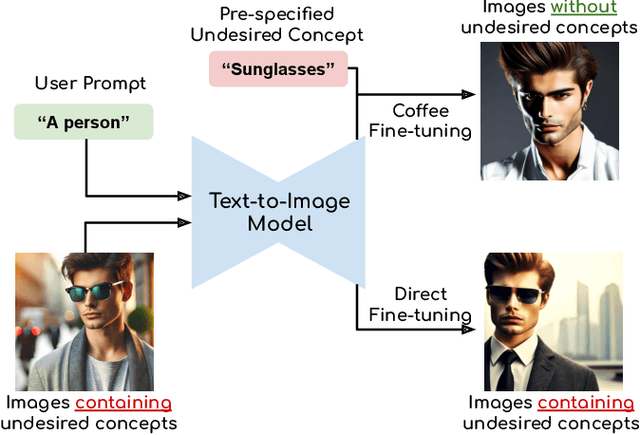
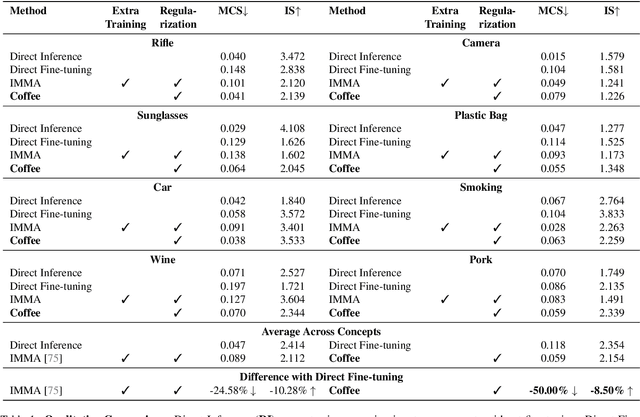
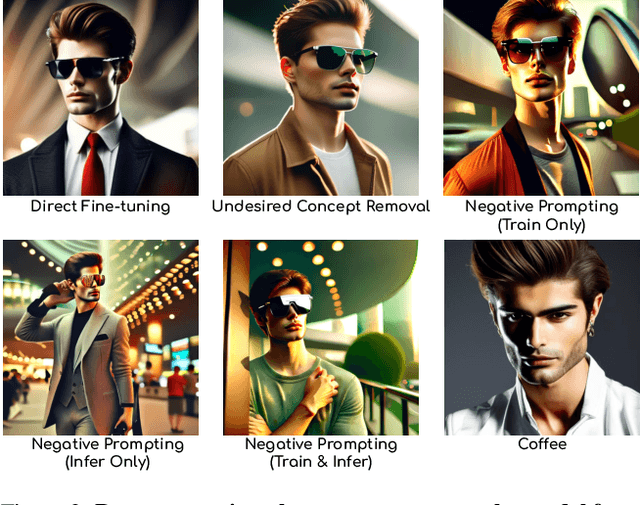
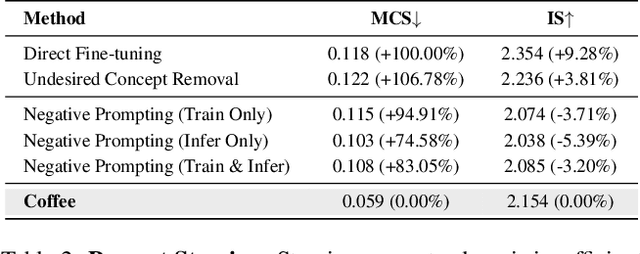
Text-to-image diffusion models can generate diverse content with flexible prompts, which makes them well-suited for customization through fine-tuning with a small amount of user-provided data. However, controllable fine-tuning that prevents models from learning undesired concepts present in the fine-tuning data, and from entangling those concepts with user prompts, remains an open challenge. It is crucial for downstream tasks like bias mitigation, preventing malicious adaptation, attribute disentanglement, and generalizable fine-tuning of diffusion policy. We propose Coffee that allows using language to specify undesired concepts to regularize the adaptation process. The crux of our method lies in keeping the embeddings of the user prompt from aligning with undesired concepts. Crucially, Coffee requires no additional training and enables flexible modification of undesired concepts by modifying textual descriptions. We evaluate Coffee by fine-tuning on images associated with user prompts paired with undesired concepts. Experimental results demonstrate that Coffee can prevent text-to-image models from learning specified undesired concepts during fine-tuning and outperforms existing methods. Code will be released upon acceptance.
Extending Foundational Monocular Depth Estimators to Fisheye Cameras with Calibration Tokens
Aug 06, 2025We propose a method to extend foundational monocular depth estimators (FMDEs), trained on perspective images, to fisheye images. Despite being trained on tens of millions of images, FMDEs are susceptible to the covariate shift introduced by changes in camera calibration (intrinsic, distortion) parameters, leading to erroneous depth estimates. Our method aligns the distribution of latent embeddings encoding fisheye images to those of perspective images, enabling the reuse of FMDEs for fisheye cameras without retraining or finetuning. To this end, we introduce a set of Calibration Tokens as a light-weight adaptation mechanism that modulates the latent embeddings for alignment. By exploiting the already expressive latent space of FMDEs, we posit that modulating their embeddings avoids the negative impact of artifacts and loss introduced in conventional recalibration or map projection to a canonical reference frame in the image space. Our method is self-supervised and does not require fisheye images but leverages publicly available large-scale perspective image datasets. This is done by recalibrating perspective images to fisheye images, and enforcing consistency between their estimates during training. We evaluate our approach with several FMDEs, on both indoors and outdoors, where we consistently improve over state-of-the-art methods using a single set of tokens for both. Code available at: https://github.com/JungHeeKim29/calibration-token.
ODE-GS: Latent ODEs for Dynamic Scene Extrapolation with 3D Gaussian Splatting
Jun 05, 2025We present ODE-GS, a novel method that unifies 3D Gaussian Splatting with latent neural ordinary differential equations (ODEs) to forecast dynamic 3D scenes far beyond the time span seen during training. Existing neural rendering systems - whether NeRF- or 3DGS-based - embed time directly in a deformation network and therefore excel at interpolation but collapse when asked to predict the future, where timestamps are strictly out-of-distribution. ODE-GS eliminates this dependency: after learning a high-fidelity, time-conditioned deformation model for the training window, we freeze it and train a Transformer encoder that summarizes past Gaussian trajectories into a latent state whose continuous evolution is governed by a neural ODE. Numerical integration of this latent flow yields smooth, physically plausible Gaussian trajectories that can be queried at any future instant and rendered in real time. Coupled with a variational objective and a lightweight second-derivative regularizer, ODE-GS attains state-of-the-art extrapolation on D-NeRF and NVFI benchmarks, improving PSNR by up to 10 dB and halving perceptual error (LPIPS) relative to the strongest baselines. Our results demonstrate that continuous-time latent dynamics are a powerful, practical route to photorealistic prediction of complex 3D scenes.
STree: Speculative Tree Decoding for Hybrid State-Space Models
May 20, 2025Speculative decoding is a technique to leverage hardware concurrency to improve the efficiency of large-scale autoregressive (AR) Transformer models by enabling multiple steps of token generation in a single forward pass. State-space models (SSMs) are already more efficient than AR Transformers, since their state summarizes all past data with no need to cache or re-process tokens in the sliding window context. However, their state can also comprise thousands of tokens; so, speculative decoding has recently been extended to SSMs. Existing approaches, however, do not leverage the tree-based verification methods, since current SSMs lack the means to compute a token tree efficiently. We propose the first scalable algorithm to perform tree-based speculative decoding in state-space models (SSMs) and hybrid architectures of SSMs and Transformer layers. We exploit the structure of accumulated state transition matrices to facilitate tree-based speculative decoding with minimal overhead to current SSM state update implementations. With the algorithm, we describe a hardware-aware implementation that improves naive application of AR Transformer tree-based speculative decoding methods to SSMs. Furthermore, we outperform vanilla speculative decoding with SSMs even with a baseline drafting model and tree structure on three different benchmarks, opening up opportunities for further speed up with SSM and hybrid model inference. Code will be released upon paper acceptance.
Radar-Guided Polynomial Fitting for Metric Depth Estimation
Mar 21, 2025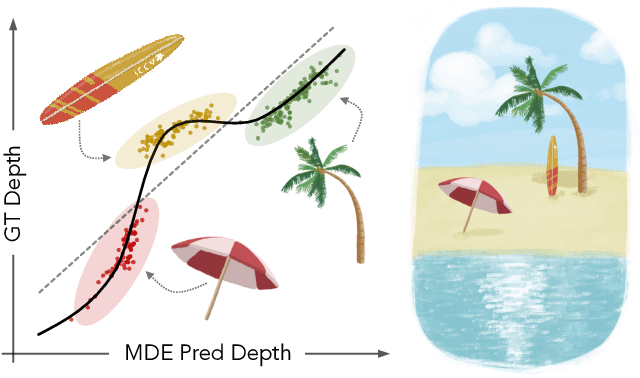

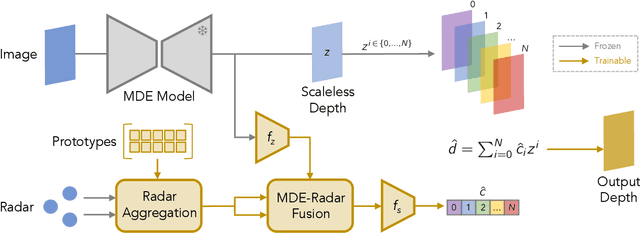
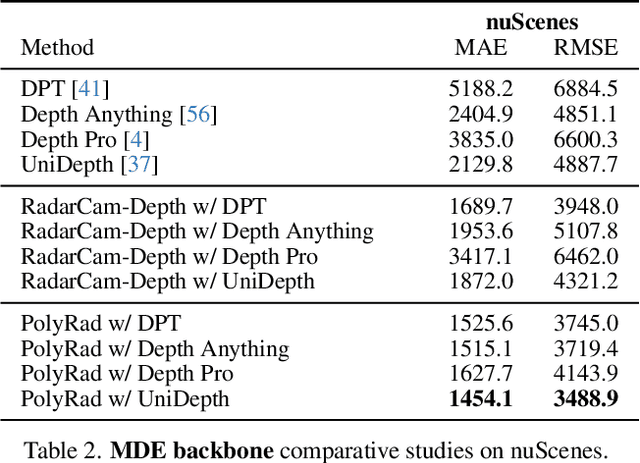
We propose PolyRad, a novel radar-guided depth estimation method that introduces polynomial fitting to transform scaleless depth predictions from pretrained monocular depth estimation (MDE) models into metric depth maps. Unlike existing approaches that rely on complex architectures or expensive sensors, our method is grounded in a simple yet fundamental insight: using polynomial coefficients predicted from cheap, ubiquitous radar data to adaptively adjust depth predictions non-uniformly across depth ranges. Although MDE models often infer reasonably accurate local depth structure within each object or local region, they may misalign these regions relative to one another, making a linear scale-and-shift transformation insufficient given three or more of these regions. In contrast, PolyRad generalizes beyond linear transformations and is able to correct such misalignments by introducing inflection points. Importantly, our polynomial fitting framework preserves structural consistency through a novel training objective that enforces monotonicity via first-derivative regularization. PolyRad achieves state-of-the-art performance on the nuScenes, ZJU-4DRadarCam, and View-of-Delft datasets, outperforming existing methods by 30.3% in MAE and 37.2% in RMSE.
Progressive Test Time Energy Adaptation for Medical Image Segmentation
Mar 20, 2025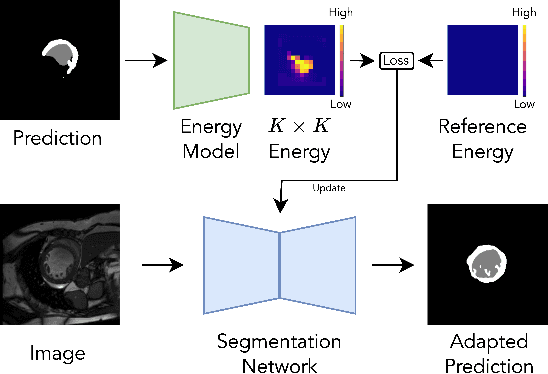
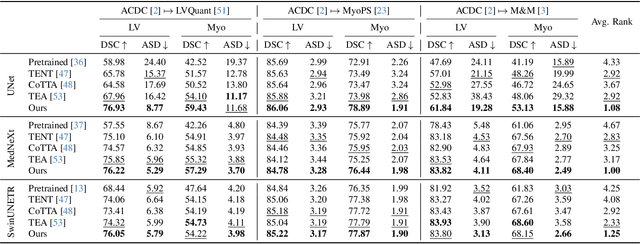
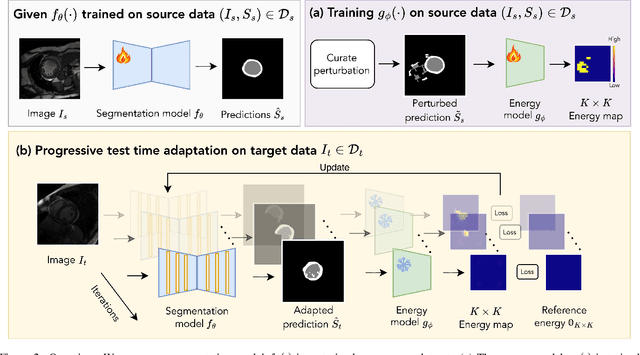
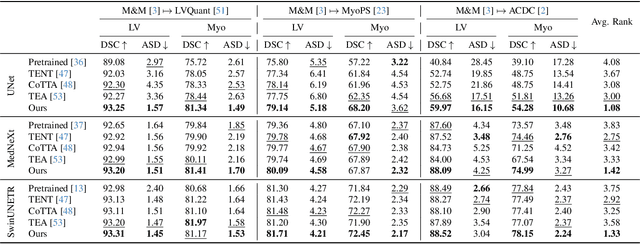
We propose a model-agnostic, progressive test-time energy adaptation approach for medical image segmentation. Maintaining model performance across diverse medical datasets is challenging, as distribution shifts arise from inconsistent imaging protocols and patient variations. Unlike domain adaptation methods that require multiple passes through target data - impractical in clinical settings - our approach adapts pretrained models progressively as they process test data. Our method leverages a shape energy model trained on source data, which assigns an energy score at the patch level to segmentation maps: low energy represents in-distribution (accurate) shapes, while high energy signals out-of-distribution (erroneous) predictions. By minimizing this energy score at test time, we refine the segmentation model to align with the target distribution. To validate the effectiveness and adaptability, we evaluated our framework on eight public MRI (bSSFP, T1- and T2-weighted) and X-ray datasets spanning cardiac, spinal cord, and lung segmentation. We consistently outperform baselines both quantitatively and qualitatively.
ProtoDepth: Unsupervised Continual Depth Completion with Prototypes
Mar 17, 2025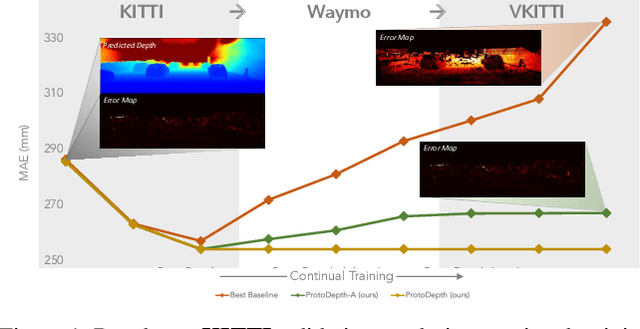
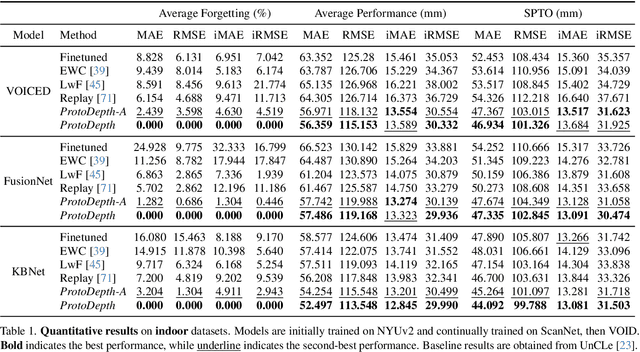
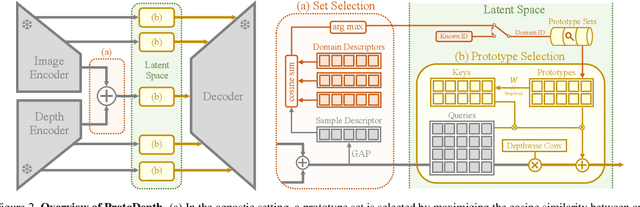
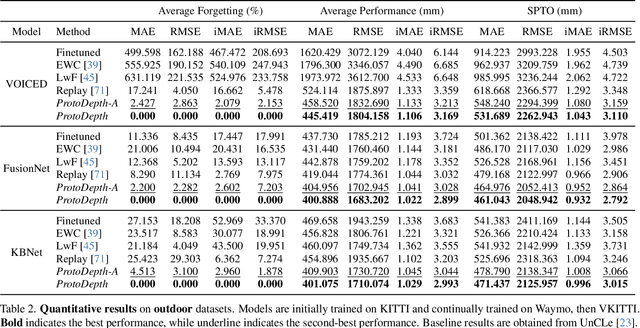
We present ProtoDepth, a novel prototype-based approach for continual learning of unsupervised depth completion, the multimodal 3D reconstruction task of predicting dense depth maps from RGB images and sparse point clouds. The unsupervised learning paradigm is well-suited for continual learning, as ground truth is not needed. However, when training on new non-stationary distributions, depth completion models will catastrophically forget previously learned information. We address forgetting by learning prototype sets that adapt the latent features of a frozen pretrained model to new domains. Since the original weights are not modified, ProtoDepth does not forget when test-time domain identity is known. To extend ProtoDepth to the challenging setting where the test-time domain identity is withheld, we propose to learn domain descriptors that enable the model to select the appropriate prototype set for inference. We evaluate ProtoDepth on benchmark dataset sequences, where we reduce forgetting compared to baselines by 52.2% for indoor and 53.2% for outdoor to achieve the state of the art.
Efficient Interactive 3D Multi-Object Removal
Jan 30, 2025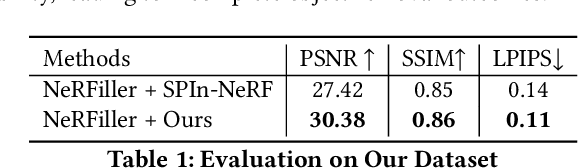
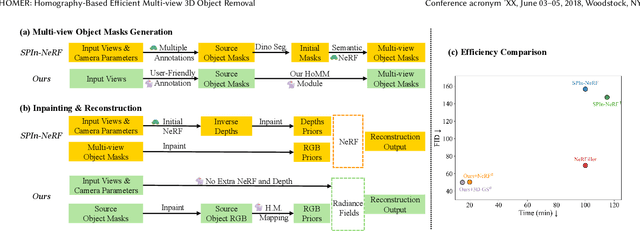
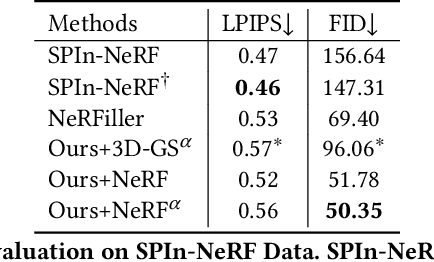
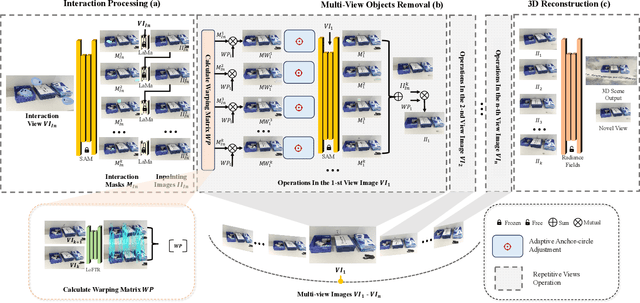
Object removal is of great significance to 3D scene understanding, essential for applications in content filtering and scene editing. Current mainstream methods primarily focus on removing individual objects, with a few methods dedicated to eliminating an entire area or all objects of a certain category. They however confront the challenge of insufficient granularity and flexibility for real-world applications, where users demand tailored excision and preservation of objects within defined zones. In addition, most of the current methods require kinds of priors when addressing multi-view inpainting, which is time-consuming. To address these limitations, we propose an efficient and user-friendly pipeline for 3D multi-object removal, enabling users to flexibly select areas and define objects for removal or preservation. Concretely, to ensure object consistency and correspondence across multiple views, we propose a novel mask matching and refinement module, which integrates homography-based warping with high-confidence anchor points for segmentation. By leveraging the IoU joint shape context distance loss, we enhance the accuracy of warped masks and improve subsequent inpainting processes. Considering the current immaturity of 3D multi-object removal, we provide a new evaluation dataset to bridge the developmental void. Experimental results demonstrate that our method significantly reduces computational costs, achieving processing speeds more than 80% faster than state-of-the-art methods while maintaining equivalent or higher reconstruction quality.